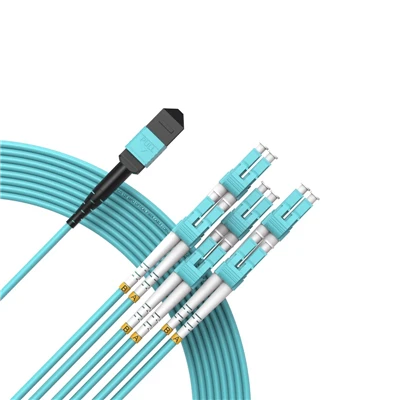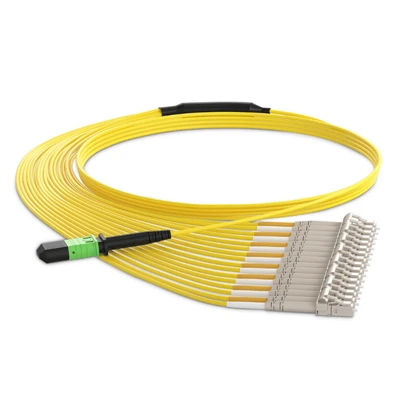


DIMI OM4 MPO Trunk Cable is a factory-terminated multimode fiber assembly using OM4 50/125 μm fiber and MPO connectors at both ends. It provides a pre-terminated MPO-to-MPO multi-fiber connection with specified fiber count, connector gender, polarity, and optical loss requirements.
Product Specifications
|
Parameter |
Specification |
|
Product Type |
OM4 MPO Trunk Cable |
|
Fiber Type |
OM4 50/125 μm Multimode |
|
Connector Type |
MPO to MPO |
|
Connector Gender |
Male (Pinned) / Female (Unpinned) |
|
Fiber Count |
8 / 12 / 16 / 24 / 32 / 48 / 72 / 96 / 144 Fibers |
|
Connector Polish |
PC |
|
Polarity |
Type A / Type B / Type C |
|
Insertion Loss |
Standard ≤0.60 dB / Elite ≤0.35 dB |
|
Return Loss |
≥20 dB |
|
Operating Wavelength |
850 / 1300 nm |
|
Jacket Types / Ratings |
LSZH / OFNR / OFNP / PVC |
|
Cable Length |
Customized |
|
Operating Temperature |
-20°C to +70°C |
|
Storage Temperature |
-40°C to +85°C |
|
Applicable Standards |
IEC 61754-7-1 / IEC 61754-7-2, IEC 61300, ANSI/TIA-568.3-E |
|
Environmental Compliance |
RoHS / REACH |
MPO Trunk Cable Configuration
For an MPO trunk cable RFQ, the connector and fiber arrangement should be defined before production. The required specification should identify the following:
Fiber count
Specify the required fiber count from the listed configurations according to the project design.
Connector gender
Specify the MPO connector gender required at each end. The selected connector should match the mating interface of the equipment, cassette, adapter panel, or other MPO component.
Polarity
Specify Type A, Type B, or Type C according to the required fiber mapping. Polarity should be confirmed against the complete connection architecture rather than selected independently.
Loss grade
Specify Standard Loss or Elite Loss according to the optical loss budget required for the complete link.
Jacket and length
Specify the required jacket rating and finished cable length according to the installation environment and cable route.
For quotation, buyers can submit a project drawing, bill of materials, or technical specification when the required MPO configuration has already been defined. DIMI can review the supplied specification before production where configuration clarification is required.
OM4 Optical Performance
OM4 Multimode Fiber
OM4 50/125 μm multimode fiber is used for multimode optical links operating at 850 nm and 1300 nm in this cable assembly.
Standard and Elite Loss
DIMI offers Standard Loss with maximum insertion loss of 0.60 dB and Elite Loss with maximum insertion loss of 0.35 dB.
Optical Link Budget
The appropriate loss grade should be selected according to the complete optical link budget, including connector losses, passive components, mated interfaces, and the optical budget of the selected transceiver.
Link Distance Considerations
Transmission distance depends on the complete optical architecture, including transceiver type, link length, connector losses, and the number of mated interfaces, rather than on the OM4 fiber designation alone.
Inspection & Testing
DIMI inspects and tests completed OM4 MPO trunk assemblies before shipment.
Optical Performance Testing
Insertion loss and return loss are tested against the specified optical requirements of the completed assembly.
01
3D Interferometer Inspection
MPO connector geometry is inspected using a 3D interferometer, including fiber height, radius of curvature, and apex offset.
02
Connector End-Face Inspection
Connector end faces are inspected for contamination, scratches, pits, and other visible defects before shipment.
03
Polarity & Continuity Verification
Fiber continuity and fiber mapping are checked against the specified polarity configuration.
04
Test Documentation
Serial-numbered test reports are supplied with shipments to associate the delivered assembly with its recorded test results.
05
Manufactured by DIMI Fiber
Certified Manufacturing System
DIMI manufactures fiber optic cable assemblies under an ISO 9001:2015 and TL-9000 certified quality management system, using automated cable cutting, stripping, and termination equipment for MPO/MTP assembly.
MPO/MTP Assembly Capacity
DIMI's fiber optic cable assembly production has a reported capacity exceeding 10,000 assemblies per day.
Engineering Specification Review
DIMI can review customer drawings and requirements for MPO connector configuration, polarity, optical loss, jacket requirements, and other project specifications before production.
Production Traceability
Finished cable assemblies are identified and documented with inspection and optical test records, with individual test reports provided with fiber optic cable assemblies.
FAQ
Q: What is the typical lead time for OM4 MPO trunk cables?
A: For standard configurations, the typical production lead time is 5–7 working days after the cable specification and order details are confirmed. Custom configurations or larger project quantities may require a different schedule.
Q: Can I order an OM4 MPO trunk cable sample before bulk production?
A: Yes. A sample can be produced for specification verification before bulk production. This allows buyers to confirm the physical assembly and agreed configuration before the production order is released.
Q: Can the OM4 MPO trunk cable be customized with OEM labeling?
A: OEM labeling can be specified for project orders. Label content, format, identification requirements, and placement should be confirmed before production.
Q: How is an OM4 MPO trunk cable normally packaged for shipment?
A: MPO trunk cables are typically individually protected and packed to reduce the risk of connector contamination and mechanical damage during transportation. Packaging requirements can be confirmed according to the cable configuration and shipment conditions.
Q: What is the difference between an MPO trunk cable and an MPO harness cable?
A: An MPO trunk cable uses MPO connectors as the primary multi-fiber interfaces at its ends, while an MPO harness cable typically transitions from an MPO connector to individual duplex or simplex connectors. The required assembly depends on the connection architecture.
Q: What is the difference between male and female MPO connectors?
A: Male MPO connectors use guide pins, while female MPO connectors do not. The connector gender should match the mating MPO interface specified for the equipment or connectivity component.
Q: What is the difference between LSZH, OFNR, OFNP, and PVC cable jackets?
A: LSZH jackets are commonly selected where low smoke and halogen-free material characteristics are required. OFNR and OFNP are flame-retardant ratings commonly used for riser and plenum installations in North American structured cabling, while PVC is a common jacket material for applications where the required installation rating permits its use. Final jacket selection should follow the applicable local building and fire codes.
Q: What is the difference between OM4 and OS2 MPO trunk cables?
A: OM4 uses 50/125 μm multimode fiber and is intended for multimode optical links, while OS2 uses single-mode fiber for single-mode transmission. The required fiber type depends on the optical transceivers, network architecture, and transmission requirements of the planned link.
Hot Tags: om4 MPO trunk cable, China om4 MPO trunk cable manufacturers, suppliers, factory