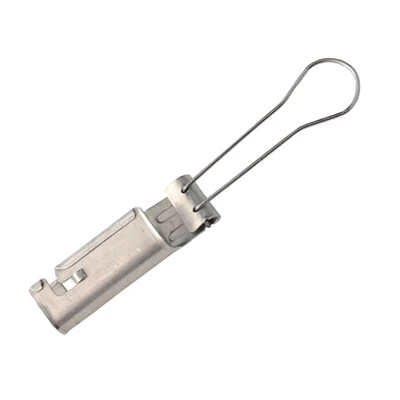


The Standard Banding Tool is a manual tensioning tool designed for installing stainless steel and other metal banding around poles, cables, brackets, signs, and utility hardware. Its drop-forged construction combines a tensioning mechanism, spring-loaded gripper, and built-in cutter in one hand tool. The tool is suitable for telecom, fiber optic, utility, municipal, and general infrastructure fastening where controlled band tension and a secure buckle connection are required.
Tool Specifications
|
Parameter |
Specification |
|
Tool Type |
Manual banding tool |
|
Compatible Band Width |
1/4"–3/4" (6.35–19.05 mm) |
|
Compatible Band Thickness |
0.015"–0.030" (0.38–0.76 mm) |
|
Maximum Tension |
2,400 lbf (10.68 kN) |
|
Tool Length |
10" (254 mm) |
|
Tool Weight |
4.0 lbs (1.8 kg) |
|
Tool Operating Temperature |
-40°F to 150°F (-40°C to 65°C) |
|
Operation |
Manual |
|
Finish |
Blue epoxy powder coating |
Tool Structure & Operating Principle
The tool uses a mechanical tensioning system to tighten metal banding around the workpiece before the buckle is secured.
Drop-forged tool body: Provides the main load-bearing structure for manual tensioning.
Tensioning mechanism: Converts handle rotation into controlled band tension.
Spring-loaded gripper: Holds the band during tensioning and helps maintain band position.
Tool nose and gripper block: Guide and retain the band during tensioning and buckle forming.
Rollover mechanism: Forms the band connection around the buckle after tension has been applied.
Integrated cutter: Removes excess band after the connection has been formed.
The operating principle is based on three mechanical actions: gripping the band, applying tension, and forming the buckle connection. The tool does not supply power or heat; all tensioning and cutting operations are performed manually.


Operating Procedure
Select the band and buckle: Confirm that the band width, thickness, material, and buckle are compatible with the tool and application.
Wrap the band: Pass the band around the pole, cable support, bracket, or other workpiece and route it through the buckle according to the buckle design.
Position the tool: Insert the band into the tool's gripping area while keeping the buckle correctly positioned.
Apply tension: Operate the tensioning mechanism until the band reaches the required installation tension.
Form the connection: Roll the tool over the buckle while controlling the tensioning mechanism to maintain the band position.
Cut the excess: Use the integrated cutter to remove the remaining band tail.
Complete the buckle: Secure the buckle according to its specific design and installation requirements.
For consistent fastening, the band should remain correctly aligned with the buckle throughout tensioning and rollover. The required tension and buckle-closing method should follow the applicable banding system specification.
Compatible Banding & Buckles
The tool is designed for metal banding within its specified dimensional range. Typical stainless steel options include 201, 304, and 316, with material selection based on corrosion exposure and project requirements.
Compatible buckle systems may include:
Ear-Lokt buckles: Traditional buckle design for manual banding applications.
Tru-Lokt buckles: Buckle design developed for compatible manual banding systems and visual confirmation of buckle-wing movement during installation.
Other compatible stainless steel buckles: Must match the selected band width and follow the applicable installation requirements.
Applications
Fiber Optic Cable Installation
Securing cable brackets, clamps, and supporting hardware to poles.
01
Aerial Telecom Infrastructure
Installing cable-related hardware on utility poles and other structures.
02
Utility And Municipal Projects
Mounting signs, communication equipment, and other pole-mounted hardware.
03
Industrial Fastening
Securing pipes, hoses, brackets, and equipment with metal banding.
04
Outdoor Infrastructure
Applications requiring stainless steel band-and-buckle fastening.
05
Quality Inspection
Quality control should cover both incoming components and finished-tool performance. Recommended inspection items include:
Dimensional inspection: Tool length, critical mating dimensions, and band compatibility.
Functional inspection: Smooth operation of the tensioning handle, gripper, cutter, and rollover mechanism.
Tension performance: Verification that the tool achieves the specified tension range without abnormal slipping or mechanical deformation.
Cutting inspection: Check that the cutter handles the specified maximum band thickness and produces a clean cut.
Surface inspection: Check coating integrity, exposed metal, corrosion, burrs, and other visible defects.
Assembly inspection: Verify fasteners, moving components, handle retention, and overall mechanical integrity.
FAQ
Q: Can I order samples before placing a bulk order?
A: Yes. Sample orders are available for product evaluation, compatibility testing, and distributor qualification. Sample quantity, price, and shipping cost can be confirmed according to the intended application.
Q: What payment terms are available?
A: We usually accept T/T, L/C, PayPal, and credit card. If you require another payment method or have specific payment terms, these can be discussed before order confirmation.
Q: Can the tool be supplied with matching band and buckles?
A: Yes. The tool can be supplied as part of a complete banding package, including stainless steel band and compatible buckles.
Q: Can the tool be supplied with private labeling?
A: Yes. OEM/private-label supply can include logo marking, product labels, color requirements, and customized packaging. Artwork and marking specifications should be approved before mass production.
Q: How should the tool be stored when not in use?
A: Store the tool in a dry, clean environment and protect the tensioning and cutting mechanisms from moisture, dust, and impact. For long-term storage, lightly lubricate applicable moving parts according to the maintenance instructions.
Q: Are replacement parts available?
A: Replacement parts can be supplied for commonly serviceable components such as the cutter, gripper, tensioning components, and other mechanical parts, subject to model and availability. Spare-part requirements should be specified when ordering for long-term projects.
Q: What documents can be provided with an order?
A: Typical commercial documentation includes a commercial invoice, packing list, and shipping documents. Product drawings, inspection records, material-related documents, or other technical documentation can be supplied when required by the project or purchase specification.
Q: How should I specify the tool when requesting a quotation?
A: Provide the required quantity, target application, preferred band and buckle system, OEM or private-label requirements, packaging requirements, destination country, and requested trade term. This information allows the quotation to cover the correct product configuration, packing, and delivery arrangement.
Hot Tags: standard banding tool, China standard banding tool manufacturers, suppliers, factory