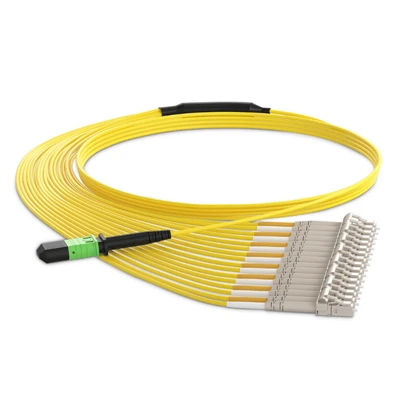

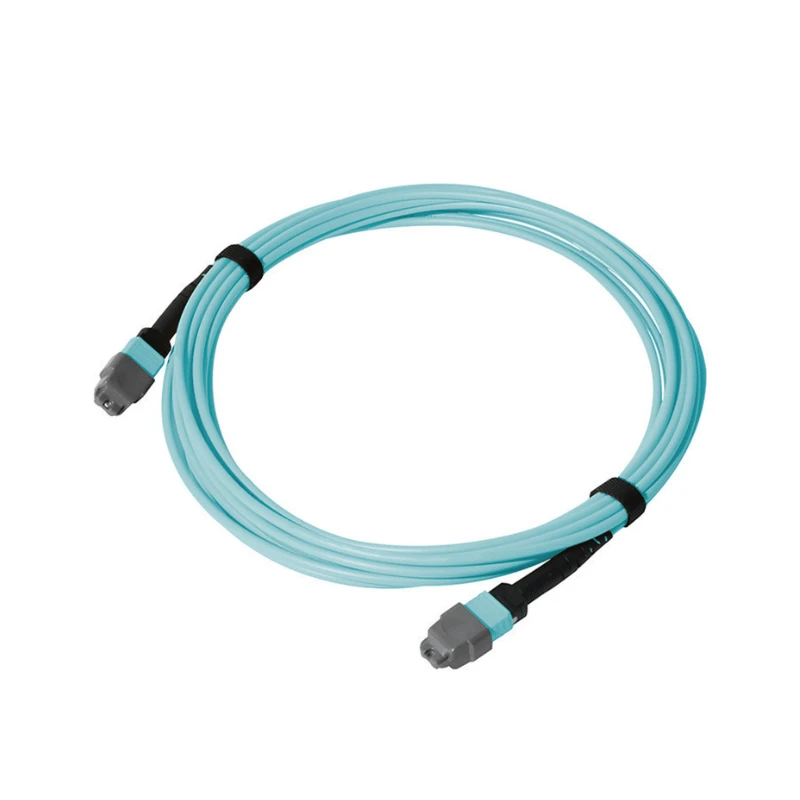
The MPO Polarity Conversion Cable is a factory-terminated fiber assembly designed to correct fiber-position or Tx/Rx polarity mismatches in high-density MPO/MTP cabling systems. It provides a controlled transition between different polarity configurations without requiring replacement of an existing trunk or backbone cable.
Technical Specifications & Configuration
|
Parameter |
Specification |
|
Connector |
MPO/MTP, male or female |
|
Fiber Count |
8, 12, 16, 24, 32, or 48 fibers |
|
Fiber Type |
OS2, OM3, OM4, OM5 |
|
Polarity |
Type A, Type B, Type C |
|
End-Face |
UPC or APC, according to application |
|
Standard IL |
≤0.35 dB |
|
Ultra-Low IL |
≤0.20 dB |
|
Return Loss |
≥50 dB UPC / ≥60 dB APC |
|
Cable Construction |
Round, micro-distribution, or ribbon |
|
Jacket Options |
LSZH, PVC, OFNR, OFNP |
|
Operating Temperature |
-20°C to +70°C |
|
Applicable Standards |
IEC 61754-7, TIA-604-5 (FOCIS 5), RoHS |
Connector & Polarity Compatibility
MPO polarity defines how fiber positions correspond between the two ends of an assembly. Type A uses straight-through fiber mapping, while Type B reverses the fiber sequence; Type C performs pair-wise fiber reversal. These methods form part of a complete cabling architecture and should not be mixed arbitrarily.
MPO connectors are available with guide pins (male) or without guide pins (female). Connector gender must match the mating equipment, trunk, cassette, adapter, or patch panel. Key orientation must also be specified where required because adapter and connector keying affects the resulting polarity.
OEM & Customization
Customization can include:
Fiber count: 8F to 48F configurations
Connector: MPO/MTP male or female
Polarity: Type A/B/C or customer-defined mapping
Fiber grade: OS2, OM3, OM4, or OM5
End-face: UPC or APC
Jacket: LSZH, PVC, OFNR, or OFNP
Cable length: Customer-specified
Identification: Cable labels, polarity marking, and private labeling
Packaging: Neutral or customer-specific packaging
Applications
Data Center Cabling
Corrects polarity mismatches between MPO trunks, cassettes, patch panels, and active equipment.
01
Network Migration
Supports reconfiguration when existing MPO infrastructure is connected to equipment using a different polarity arrangement.
02
High-Density Cross-Connects
Provides a compact transition where space and port density limit the use of conventional patching.
03
Telecom & ODF Systems
Used for controlled fiber mapping between distribution equipment and MPO-based assemblies.
04
MPO Modular Systems
Integrates with MPO/MTP trunks, cassettes, adapter panels, and other factory-terminated assemblies.
05
Quality Control & Testing
Each assembly should be verified against the ordered fiber mapping, connector gender, fiber count, and end-face configuration before shipment. Optical testing includes insertion loss (IL) and return loss (RL), while connector end-face geometry can be inspected by 3D interferometry.
Individual test documentation can be supplied for project or distributor orders. Production inspection also verifies connector termination, polarity identification, cable length, labeling, and overall assembly condition to reduce installation errors in high-density systems.
FAQ
Q: How do I confirm the correct polarity conversion cable for an existing MPO link?
A: Provide the existing trunk or equipment connection diagram, connector gender, key orientation, fiber count, and required Tx/Rx mapping. We can use these details to confirm the required conversion configuration before production.
Q: Can different polarity conversion cables be connected in the same optical link?
A: They can be physically connected in some configurations, but the resulting fiber mapping must be checked against the complete link design. Multiple polarity changes should not be introduced without verifying the end-to-end Tx/Rx path.
Q: Can you provide samples before a bulk production order?
A: Yes. Samples can be produced for configuration verification before mass production. For customized assemblies, the sample specification should be approved before the production batch is released.
Q: What is the typical production lead time?
A: Standard configurations are typically dispatched within 3–5 working days. Custom OEM orders generally require 7–12 working days, depending on quantity, configuration, and material availability.
Q: How should MPO polarity conversion cables be packaged for international shipment?
A: Assemblies should be individually protected against connector contamination, bending, and mechanical impact, then packed in cartons suitable for export transportation. For larger or project orders, packaging labels can include part numbers, quantities, cable lengths, and customer-specific identification.
Q: Can the cable be used in high-density rack environments with repeated patching?
A: Yes. It is suitable for rack-level and cross-connect environments where MPO connections are frequently accessed. Proper cable routing, strain relief, and connector protection should be maintained to prevent mechanical stress during repeated patching.
Q: How should unused MPO connectors be protected during storage or installation?
A: Unused connectors should remain covered with clean protective dust caps and be stored in a dry, contamination-controlled environment. Connector end faces should be inspected and cleaned with an appropriate MPO cleaning tool before mating.
Hot Tags: MPO polarity conversion cable, China MPO polarity conversion cable manufacturers, suppliers, factory